

INTRODUCTION
The holy grail of home- and sometimes craft brewing lies somewhere between the questions of how long I can store my yeast between re-pitching and whether online calculators are telling the truth with yeast viability loss over time. While we can’t easily answer those particular questions without the additional effort and resources, we can give you clear evidence that yeast propagated with the need of every strain in mind, will perform really well, even if stored (cold) for several months.
Why should it be stored cold? How cold? All have been discussed in the literature published many years ago i.e. Bishop, 1955. We have simplified and explained this topic in non-technical language in our upcoming #02 newsletter. Subscribe to the newsletter.
There are many factors influencing yeast shelf-life except storing temperature. To this the most important is the metabolic condition and nourishment of a yeast cell. As you may already have noticed, yeast taken from fermentation will not be in the same fitness shape as the propagated one. Therefore, for now, we will take a closer look only at the latter situation.
The whole study began with the idea of testing the shelf life of liquid yeast propagated with a meticulously crafted propagation that we were focused on even before Yeast Side Labs started. We have seen over time that many nutrition regimens and propagation protocols will not result in a satisfactory viability of cropped yeast, not to speak about the shelf life. With homebrewers’ yeast pouches, we decided to investigate it accurately and consistently. The test focused on yeast viability over time and the performance at the late time of planned storage time.
One of the most critical questions in both homebrewing and craft brewing is how long yeast can be stored between re-pitching and whether online viability calculators accurately predict yeast degradation over time. While we can’t answer these questions definitively without extensive research, we can provide clear evidence that yeast propagated with strain-specific requirements in mind performs exceptionally well, even when stored cold for several months.
Why Should Yeast Be Stored Cold?
Beyond storage temperature, several other factors influence yeast shelf life. One of the most important is the metabolic condition and nutrient reserves of the yeast cells. Yeast harvested from fermentation will not have the same fitness shape as freshly propagated yeast. Therefore, in this study, we focus exclusively on the latter.
Study Overview
This study was inspired by our commitment to understanding and optimizing the shelf life of liquid yeast. Even before the establishment of Yeast Side Labs, we recognized that many propagation protocols and nutrient regimens fail to sustain high viability over time. With homebrewers’ yeast pouches, we set out to investigate yeast viability and fermentation performance over an extended storage period.
Tests and Results
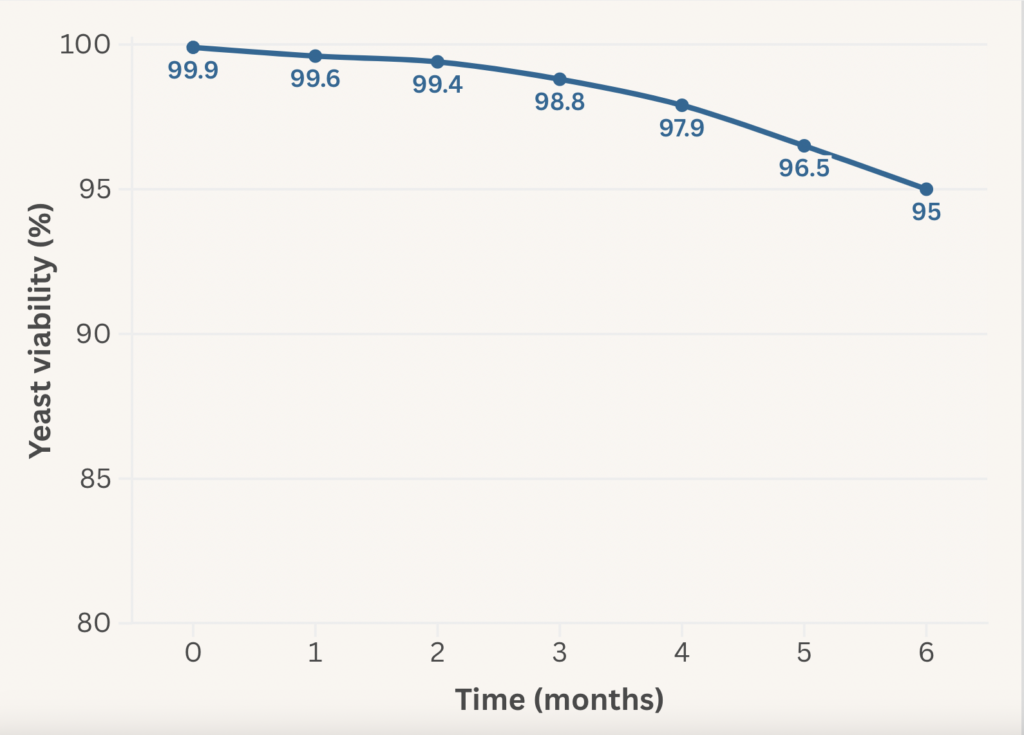
Our first test subject was the Manchester Ale (YS107) strain, propagated using our standard procedure. The yeast was packaged in homebrew pouches and stored at 4°C for six months. Viability was tested in triplicates (each with two chamber counts, using samples from three different pouches) using a haemocytometer, Erythrosin B and Methylene Blue. Viability assessments were conducted on the day of packaging and at monthly intervals for six months.
On the day of packaging, viability was >99.9% (it is never truly 100%, despite some claims). Over the next two months, viability remained above 99%, gradually decreasing to 95% by the sixth month (Fig. 1).
Fermentation Performance
Now, what does it actually mean? Will the yeast perform as supposed to? To this end we performed two trial batches of standard brewing wort prepared from LME, one at the day of packaging (fresh) and the other at 6th month of storage (aged).
Experimental Conditions:
-
- Fermentations were performed using 200–300 mL of 11,8°P wort at 20°C for eight days.
-
- The pitch rate was consistent across trials at 0,5 million cells/mL/°P (6 million cells/mL total).
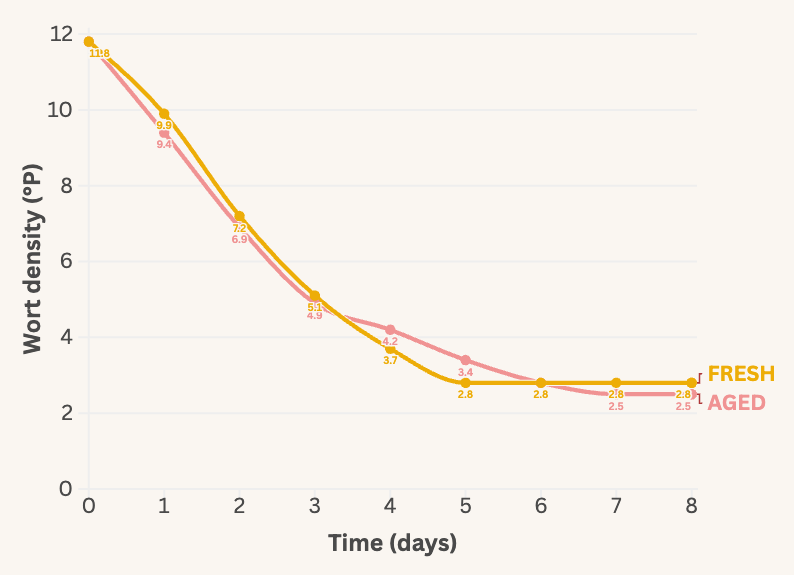
Fig. 2. Fermentation perfomance of freshly propagated yeast (FRESH) and stored cold for six months (AGED).
Key Findings:
-
- Freshly propagated yeast and stored yeast exhibited similar fermentation rates in the early stages.
-
- Fresh yeast reached the expected final gravity 1,5 days faster than stored yeast.
-
- Stored yeast showed slightly stronger diacetyl formation midway through fermentation, likely due to differences in how stored yeast responds to low-oxygen conditions. (Note: The fermentation media was not oxygenated.)
-
- A yeast starter can help mitigate these minor differences when using yeast closer to its expiration date—something many homebrewers already practice.
Importantly, our homebrewers’ pouches contain 200 billion viable cells at packaging, resulting in a higher pitch rate (~0,85 million cells/mL/°P) for a 20L batch. This higher pitch rate helps reduce diacetyl risk when oxygenation is performed correctly (recommended 13–15 ppm for this strain), ensuring optimal fermentation quality.
What’s Next?
This experiment is ongoing, and we plan to expand our research to other strains in our core lineup. Future tests will explore:
-
- Oxygenation in fermentation trials to assess its impact on performance.
-
- Increased pitch rates (7,5 million cells/mL total) to determine its effect on lag time and diacetyl formation.
-
- Use of antioxidants like ascorbic acid at packaging to further improve yeast shelf life.
-
- Modification of storage media pH levels and testing linoleic acid as a substrate for ergosterol synthesis and plasma membrane stability.
By refining our propagation methods and storage conditions, we aim to push the limits of liquid yeast stability and performance, providing brewers with the highest quality yeast possible.
Author: Kamil F. Tomaszewski


